African Origins of Binary Code: What the World Ifa Festival 2026 Reveals
Posted by IDMANN FERRIS

The Mathematics Most People Never Learn
Last month, thousands of Babalawos, traditional rulers, and diaspora followers gathered at the sacred grounds of Oke Igeti in Ekiti State, Nigeria, for the World Ifa and Orisa Festival and Spiritual Pilgrimage 2026. Through the traditional casting process, Oturupon Meji was revealed as the governing Odu for the current Ifa year.
Most people who saw coverage of the festival did not make the connection. But they should.

What happened at Oke Igeti was more than a spiritual ceremony. It was the continued operation of one of the world's oldest living systems of symbolic logic, information organization, and mathematical pattern generation.
Every computer on earth operates on binary logic. Two discrete states. On or off. One or zero. Eight binary positions arranged in sequence produce one byte holding exactly 256 possible values. That is not arbitrary. That is base 2 mathematics. 2 to the power of 8 equals 256. That combinatorial structure is the computational foundation every processor, every operating system, every digital architecture on earth is built on.
West Africa's Ifa divination system operates on identical logic. Each iteration of the divination process produces one of two discrete outputs. A single mark or a double mark. Those outputs are arranged sequentially generating combinations that map to one of exactly 256 Ifa Odu. The Ifa Odu are the sacred encoded repositories of West African knowledge spanning philosophy, medicine, mathematics, and governance developed and maintained by the Yoruba people of West Africa centuries before modern computing existed. Two discrete states, sequential combination, 256 total configurations. The same combinatorial architecture that defines modern computing.
The West engineered the hardware centuries later. The mathematical framework and origins was already running in West Africa.
Gottfried Leibniz German philosopher and mathematician is credited with formalizing binary arithmetic in 1703. But binary-style symbolic systems existed in several knowledge traditions long before the digital age, including Ifa and other divination systems across Africa and beyond.

Gottfried Leibniz, in his dissertation, “Combinatoria” changes the I and II in sand divination to 1 and 0, which became today’s binary code used by all computer and digial devices worldwide.
This follows a familiar pattern. Europeans have been credited with discovering algebra, geometry, and calculus, fields with deep roots in African and Arab scholarship that preceded them by thousands of years. Even in artificial intelligence, Black intellectual contributions have been obscured. David Blackwell, whose pioneering work in game theory and statistical decision theory laid the foundational principles for modern AI, remained largely unknown outside academic circles for decades. Nvidia thought differently by naming their most advanced GPU architecture, the Blackwell platform, in his honor. The crediting of discovery has never been purely about who arrived first. It has always also been about who controlled the narrative.

Nvidia is honoring him as the father of AI. He is one of many Africans and African Americans whose contributions to science, technology, and civilization were never lost. They were simply never told by those who control the institutions that write history.
The Netflix film Hidden Colors tells the story of the Black women NASA called "human computers," the only ones capable of performing the complex mathematical calculations required for the early space program and lunar missions. Among them: Katherine Johnson, Dorothy Vaughan, and Mary Jackson. Johnson calculated trajectories for the first American in space, the first American in orbit, Apollo 11 to the Moon, and the emergency return path that helped bring Apollo 13 home alive but nothing an=bout them is taught in school.
The inventor of the digital cell phone, Jesse Russell is a Black American engineer and inventor who created the technology behind the digital cell phone while working at Bell Laboratories. His patent number 5,084,869 filed in 1989 and granted in 1992 covers the foundational technology for transmitting digital signals over cellular networks. Before his invention cell phones were analog. Every digital phone call, text message, and mobile data connection in use today traces back to his work. The technology is embedded in an industry worth trillions of dollars and used by billions of people worldwide. Most people have never heard his name.
This is not coincidence. This is a continuum from ancient African people.
Documented records tells a different story than what is taught in schools. The Rhind Mathematical Papyrus, authored by African mathematician Ahmose around 1700 BC, documents algebra, geometry, and trigonometry more than a thousand years before Greek mathematics existed.

The word algebra itself derives from Al-Kemit, the ancient name for Egypt. Pythagoras, Socrates, Plato, and Aristotle all traveled to Kemet to study under African priest-scholars at the temple universities of Waset and Ipet Isut, carrying African knowledge back into what became the foundation of Western philosophy and science. Plato studied there for thirteen years. Even the Trivium and Quadrivium, the Egyptian system of liberal arts covering grammar, logic, rhetoric, arithmetic, geometry, music, and astronomy that became the foundation of every major European university including Harvard and Oxford, was drawn directly from the Egyptian Mystery System taught at those same temple universities thousands of years earlier. Those subjects are literally inscribed in stone over the doorways of the Old Schools Quadrangle at Oxford's Bodleian Library, built between 1613 and 1624. Every time a student walks into Oxford, Harvard, or any Western university and studies mathematics, philosophy, logic, rhetoric, or astronomy, they are engaging with a curriculum whose architecture originated in ancient Africa. The building just has different signs on the doors now.
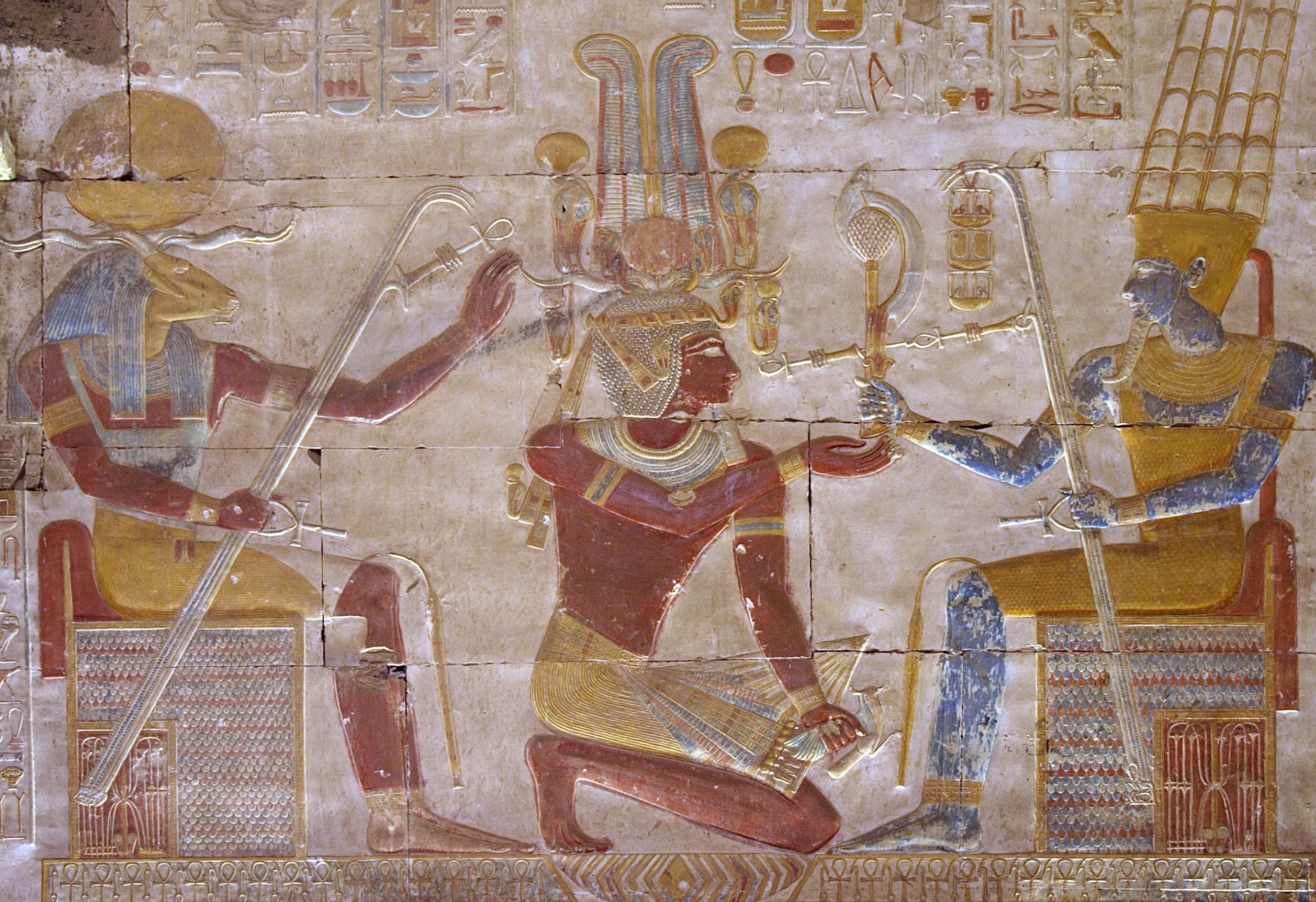
There also seems to be a general consensus, even among Africans, that the Ancient Egyptians were not African. But any visit to Egypt tells a different story. The people carved on the walls of the Old Kingdom confirm that those who built the pyramids using advanced geometry, trigonometry, arithmetic, and quadratic equations were African.
Ancient Egypt was called Kemit which means black Lands. Greeks used the term Aithiops to describe Egyptians meaning "burnt face"
More proof is that, the ancient Egyptian language is part of the Afro Asiatic language family, still spoken in West Africa today.
For those who cannot afford a ticket to Egypt or the time to read books on the subject, the question remains simple: Is Egypt not in Africa? Is the ancient Egyptian language not part of the Afro Asiatic language family still spoken across West Africa today? A simple YouTube search reveals the interiors of temples and structures that clearly show preserved images of the original people from the OLD KINGDOM.
This is not taught in elementary, middle, high school, or college history. You have to major in history with a concentration in Egyptology for this to become second nature. Below is a small sampling of the evidence:
Mastaba Tombs, 3100 to 2686 BC (5,000 years ago). There were no Europeans in North Africa during this period.
https://youtube.com/shorts/lMBSYxxWEj0?si=DJNA0XHOhihfea5U
Tomb of Mereruka, 2340 BC (approximately 4,000 years ago). These are African people. The same people found next door in modern Sudan and across the border in modern Libya.
https://youtube.com/shorts/y7e0mrA2kU0?si=xAl1pjAMJBSBMePt
West Africa's connection to binary code has been studied for decades and is only now reaching the mainstream. This observation is not the work of a single researcher.
As early as 1983, Olu Longe of the University of Ibadan delivered an inaugural lecture titled Ifá Divination and Computer Science, formally drawing the connection between the ancient Yoruba divination system and the logic structures underlying modern computing. That lecture predates most of the mainstream conversation on this subject by more than 40 years.

Computer scientist Tunde Adegbola has explored the mathematical structure of Ifá and its relationship to computation. Peter N. Eze has compared Ifá divination systems to modern computer systems and information processing. Andre Croucamp has described African divination systems as information technologies, while Erwan Dianteill and Oludamini Ogunnaike have documented the mathematical and geomantic traditions that spread throughout Africa and beyond.
This is not a fringe theory. It is a body of academic work spanning multiple continents and decades, rooted in one of the oldest and most sophisticated knowledge systems on earth.

Ron Eglash, in his landmark work African Fractals, demonstrated how African knowledge systems employ recursion, algorithmic generation, binary processes, and mathematical structures that parallel concepts found in modern computing.
Taken together, these scholars present a compelling picture. African divination systems were not merely spiritual traditions. They were also sophisticated systems for organizing, encoding, transmitting, and interpreting information. The Internation organization UNESCO itself recognized this, formally inscribing the ancient 256 binary Ifá divination system on its Representative List of the Intangible Cultural Heritage of Humanity, noting that it makes use of an extensive corpus of texts and mathematical formulas practiced among Yoruba communities and throughout the African diaspora in the Americas and the Caribbean. UNESCO
What Mainstream Institutions Now Acknowledge
This is no longer a fringe conversation.
The London School of Economics published an article in August 2025 titled "What Ifa, an Indigenous Binary Knowledge System, Can Teach Us About AI," highlighting the relevance of Ifá's 256 Odu structure to discussions surrounding artificial intelligence and knowledge systems.
The United Nations University published research in February 2026 exploring what happens when AI models are trained on African wisdom corpora, bringing increased attention to African intellectual traditions and their relevance to modern technology.
Wikipedia's entry on binary numbers now notes that binary combinations similar to those found in the I Ching have also been used in traditional African divination systems such as Ifá and in medieval geomancy.
The recognition is growing. The scholarship is expanding. The conversation is changing.
Why the World Ifá Festival Matters
The festival that concluded last month at Oke Igeti is significant beyond its spiritual meaning. It demonstrates that the Ifá system is not a historical artifact. It remains a living tradition practiced throughout Nigeria and the African diaspora.
When Babalawos gathered to determine the governing Odu for the coming year, they participated in a tradition that has preserved complex symbolic and mathematical structures for centuries.
The Poster That Documents the Full Lineage
The African Origins of Computers and Binary Code timeline poster traces this history from its roots in Ifá divination through its documented connections to mathematics, information systems, geomancy, and modern computational thought.
Available as a 17 x 39 inch timeline poster, printed on premium paper and designed as a reference piece for homes, classrooms, libraries, and offices.


Own the full story: https://www.personaladvisory.com/collections/art-prints/products/african-origins-of-computers-binary-code-poster
Sources:
Tunde Adegbola, The Mathematics of Ifá; André Croucamp, Traditional African Divination Systems as Information Technology;
Ron Eglash, African Fractals: Modern Computing and Indigenous Design;
Peter N. Eze, A Philosophical Analysis of Computer and Ifa Divination Systems; William Bascom, Ifa Divination: Communication Between Gods and Men in West Africa;
Erwan Dianteill, Venus as a Boy: Geomancy Divination in Africa, Europe and the Arab World;
Oludamini Ogunnaike, Sufism and Ifa: Ways of Knowing in Two West African Intellectual Traditions.
Acknowledgements: Adaobi Chimelu, Baba Sixto, Ekaro Awo, Obasina
Questions about wholesale or bulk orders? Reach us at contact@personaladvisory.com